
After 60 years of shooting pro and amateur I am still not sure I am the guy you should ask about the Zone System as described by master photographer Ansel Adams.
Invented by Adams 80 years ago the Zone System is used in black and white photography as a relative quick way of determine the tones of gray from absolute white on through to absolute black.
There only a few ways to change the tones captured in a black and white image. The easiest is to change the exposure of the image in the camera. Next you can change the development time and processing of the film. Having said that if you haven’t captured the tones you need on your negative you’re not going to get them back in the processing of the film in the development tank. Yes you can change the contrast and even the amount of grain but the perfect negative is made in the camera and not in the darkroom.
To use the Zone System in the camera you need a light meter (a spot meter is best but you can get away with an incident light meter or a reflective meter in or on the camera itself).
Then according to Adams to use his Zone System of a scale of 11 zones with the darkest being absolute black at Zone 0 and the absolute lightest being pure white at Zone X. Each gray value, from one zone to the next, is one “stop”.
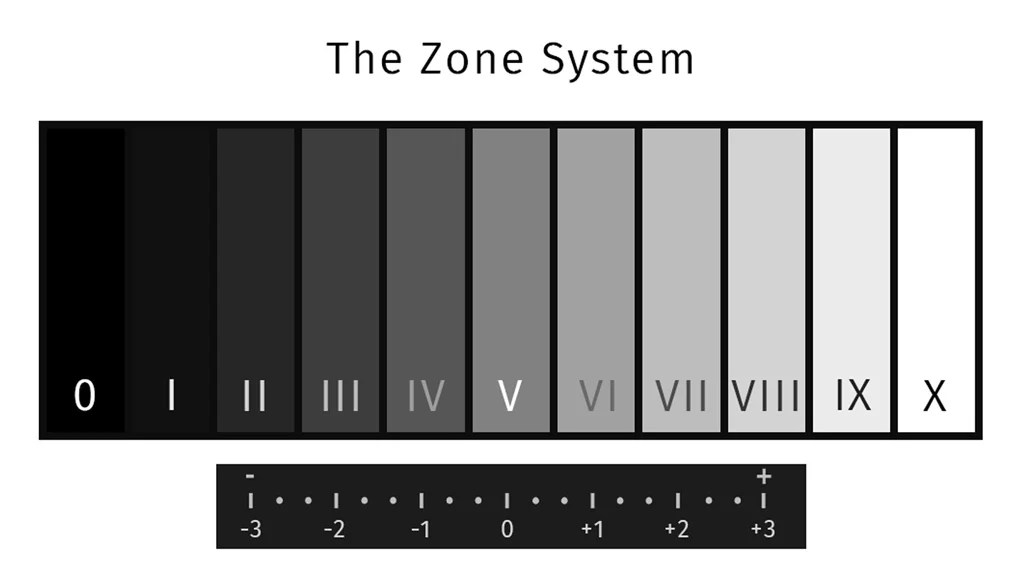
Zone V is exactly the same value as an 18% gray card. This 18% is what your camera is calibrated to see. When it comes to Zone V therefore the exact middle of the Zone System, half way between black and white is Zone V.
Because your camera doesn’t know what you’re shooting whether it be white clouds in the sky or a black cat you need to take a spot meter from the part of the composition you consider most important and move your settings on your camera appropriately.
But all film (and even more so all digital camera sensors) have a limited dynamic range. That is to say all cameras are limited in the number of zones they can capture in a single image. In other words you can’t just go out and shoot everything in Zone V settings. In the case of clouds (or snow) they will be grey. In the case of our cat the little guy will turn out as a black blob with no detail.
Wedding photographers ran into these issues all the time when shooting black and white film. They absolutely had to get the exposure right on the bride’s bright white dress. However exposing exclusively on the dress meant a loss of detail in anything of a darker hue like the groom’s suit.
I once shot a wedding image of a mix-race couple. The groom was a black man from the Caribbean and he was very black. The bride was from a Caucastion background and was blond and very white.
All of the shots of the couple exceed the dynamic range of the film and digital cameras but I got one shot that succeeded. As the couple were starting their first dance at the reception after the marriage ceremony I used a big flash to bounce light from the ceiling down on the couple which lessened the dynamic range between the two of them to something that could be captured in the camera and printed as a photo and didn’t either totally wash out the bride or block up the exposure on the groom.
Well it’s not exactly the Zone System but my point is still valid. You’re going to run into situations where the film or digital camera cannot capture the entire range of tones from white to black and you’re going to have to make some decisions about what stays and what goes. Understanding the Zone System will make these decisions a lot easier and more accurate to make.
Here’s a hint: for black and white film you want to expose to retain the shadow detail. For digital cameras you want to exposure to retain the highlights.
So why am I not the guy to write about the Zone System? First of all Adams wrote three books (The Negative, The Camera, The Print) to describe his Zone System. I have all three books. Second there are a lot of very good posts about the Zone System on line and some great videos on YouTube.
How to Use the Zone System to Make Your Best Digital Photos
Zone System In 10 Minutes or Less
Photography: Exploring Photographpy with Mark Wallace: Adorama TV
 StreetShooters
Leave a comment